

Sprocket drive unit 300 Nm 24 volts |
| Jefa 300 Nm sprocket autopilot drive unit |
| The Jefa sprocket drive is the most compact sprocket autopilot drive in the world. It's much stronger than a human being (the max. output torque of 300 Nm at 9 RPM is equivalent to 50 Kg on the rim of a 1 meter wheel) and is build for 24 hours per day continuous operation with a total weight of only 7 Kgs. The combination of the specially designed electric motor with the ultra efficient 3 stage planetary gearbox results in an extremely efficient drive unit to keep the battery charging time to the minimum. The drive can be used on boats from 45 to 75 foot (or with a rudder torque up to 400 KgM) equipped with a cable or rod steering system. Please click on the pictures for a larger view. |
|
|
|
| Main dimensions |
| The Jefa sprocket drive is very compact with a length of 2491 mm and a maximum diameter of 178 mm. As space is always a problem on sailing yachts, the compact drive unit can be integrated into the steering system even when a very limited space is available. The drive can operate on any mechanical steering system which is equipped with a rotating shaft. |
 |
| The mounting possibilities: |
|
|
| The sprocket drive can be used to drive any system with a rotating shaft. The above example show the autopilot drive driving a second sprocket on the steering shaft. |
| The construction: |
|
|
|
The above assembly drawing shows the cross section of the sprocket drive. The drive can be separated in 3 main parts: The electric motor
(1), the three stage planetary gearbox (2) and the
electro-magnetic clutch (3). The Jefa sprocket drive has multiple
advantages over existing sprocket drive units. These advantages will
be explained per section of the drive:
Electric Motor: The flat wound electric motor (pancake motor) used in the Jefa drive units is carefully selected for this application. Pancake motors have multiple advantages over normal electric DC motors:
Electro magnetic clutch: On the moment the sprocket steering system on the yacht is manually operated, the autopilot drive has to be disconnected from the steering system. This is achieved with the electro-magnetic clutch (4) and controlled automatically by the autopilot junction box. Jefa has developed a unique and patented engagement clutch. The solution is based on two electrically operated spring loaded clutch pins that engage and disengage the outer gear ring of last planetary gear step. This solution has multiple advantages over the existing friction plate clutches:
|
| Connections: |
|
|
| This illustration shows the minimal components for a working autopilot configuration. Jefa autopilot drives work together with all mayor autopilot electronics. The connection of the Jefa autopilot drive to the autopilot junction box is quite simple. The two 1.5 mm² red and black wires have to be connected to the plus and minus of the autopilot clutch line. This will make sure that when the autopilot user engages the autopilot on the control screen, the clutch will engage and allow the autopilot motor to drive the steering system. The two 4 mm² red and black wires have to be connected to the autopilot drive output connection. Now the Jefa autopilot drive is integrated into the system. |
| How to achieve the correct hard over time (autopilot speed) by varying the sprockets. |
| Following table shows the correct sprocket ratios to achieve the correct hard over time (the time needed for the autopilot drive to run through 72° of rudder travel). The ideal hard over time is between 12 and 15 seconds. As most modern autopilots have a feature called "speed control" (the speed of the autopilot can be step less controlled by pulse width modulation) it's better to aim at the 12 seconds as the autopilot can always slow down the drive when the response is too quick. It's very important to get the sprocket ratio right as a too quick autopilot drive (less than 10 seconds HO time) will be too nervous and will cause the autopilot to start swinging between port and starboard (officially named "hunting"). When the hard over time is too long, the pilot will not be able to steer the boat in heavy sees while reaching as it is unable to react quickly enough to the changing courses. The working order is as follows: First count the amount of turns lock-lock of the driving shaft (the shaft the sprocket drive will drive) assuming the rudder travel is around 72°. (If the rudder travel is more than 72°, multiply the counted turns with 72 and divide it through the measured angle). If the counted turns are more than 2.5, the drive has to be speeded up, so the drive shaft sprocket has to be smaller than the drive unit sprocket. When the counted turns are below 2.5, the drive has to be slowed down by using a bigger sprocket on the drive shaft. Jefa can supply 5/8" pitch stainless steel sprockets bored and keyed to suit every drive shaft and matching 5/8" stainless steel chain. The standard speed of the drive is 6,5 revs/minute. |
Jefa sprocket drive calculation |
||
Counted turns of drive shaft |
Drive shaft sprocket |
Autopilot drive sprocket |
| 1 | 26 | 11*1 |
| 1¼ | 21 | 11*1 |
| 1½ | 18 | 11*1 |
| 1¾ | 15 | 11*1 |
| 2 | 13 | 11*1 |
| 2¼ | 12 | 11*1 |
| 2½ | 11 | 11*1 |
| 2¾ | 11 | 13 |
| 3 | 11 | 15 |
| 3½ | 11 | 15 |
| 4 | 11 | 15 |
| 4½ | 11 | 15 |
| 5 | 11 | 15 |
| *1: This drive is as standard delivered with a 11 teeth 5/8" sprocket. Please specify when different. |
| Compatibility in 24 Volts. (not available in 12 volts use the DU-WS-200) |
| Following table shows the maximum rudder torque that can be generated by the Jefa 300 Nm sprocket drive in combination with various autopilot junction boxes. As the sprocket drive can generate much more torque than a human being, one should test the system after installation by blocking the rudder movement. This way one can determine if every part of the steering system can withstand the loading. |
| Autopilot junction box 24 Volt version. | Max. output (Amp.) | Max. rudder torque (KgM) |
| HO-time no load | 12 sec. | |
| HO-time max. load | 24 sec. | |
| Garmin GHP12 sailboat APS (*1) | 40 | 390 |
| Simrad AC12 | 12 | 390 |
| Simrad AC42 | 20 | 390 |
| Raymarine ACU-200 (*2) | 15 | 390 |
| Raymarine ACU-400 (*2) | 30 | 390 |
| Furuno Navpilot | not advisable due to lack in speed control and dynamic braking see this page | |
| B&G H5000 Pilot (*3) | 20 | 390 |
| B&G Triton Pilot - Low Current | same as Simrad AC12 - see above | |
| B&G Triton Pilot - High Current | same as Simrad AC42 - see above | |
|
| Mounting bracket for flat mounting: |
|
|
| When mounting on a surface parallel to the chain is not possible, an additional mounting bracket can be fitted to allow mounting on a flat surface. The slotted holes in the drive flange can be used for ease of tensioning of the chain in horizontal or vertical direction. |
Jefa sprocket drive units |
||
Part No. |
Description |
|
DU-WS300-24 |
Sprocket autopilot drive unit 300 Nm 24 Volts *1 |
|
DU-WS-RFB1 |
WS integrated rudder feedback for Garmin and NKE autopilots (10 kΩ)*² |
|
DU-WS-RFB2 |
WS integrated rudder feedback for Raymarine autopilots (5 kΩ)*² |
|
DU-WS-RFB3 |
WS integrated rudder feedback for B&G (NAC-2) autopilots (5 kΩ)*² |
|
DU-CAB-G |
Garmin cables and plugs mounted to drive units |
|
|
CH5800 |
5/8" non-magnetic stainless steel chain per meter |
|
|
CHLNK |
5/8" stainless steel master link |
|
DU-WS-BR |
Bracket for sprocket drive |
|
|
- |
Various stainless "plate" sprockets to be welded on shaft 11T - 26T |
|
Z4-175 |
Hub sprocket 11 teeth stainless 5/8"pitch bored and keyed to suit | |
Z4-176 |
Hub sprocket 13 teeth stainless 5/8"pitch bored and keyed to suit | |
Z4-177 |
Hub sprocket 15 teeth stainless 5/8"pitch bored and keyed to suit | |
|
*1: This drive is as standard delivered with a 11 teeth
5/8" sprocket. Please specify when different. *2: please note the maximum revolutions of the output shaft of the drive should not exceed 2,5 turns for the rudder feedback unit to work properly. |



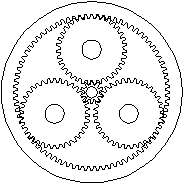 Planetary
gearbox: To achieve a correct rudder travel speed (hard over time)
the electric motor has to be reduced in speed with a factor 486:1. Some
autopilot drive producers use a worm reduction box, but the efficiency
is extremely low as the gears rub each other. Some producers use a
combination of a planetary gearbox with a 2 stage spur gear set (one
small gear and one big gear), but this creates a much bigger unit with
an offset to the centre and much heavier loaded gears. The best way to achieve
this high reduction in combination with a high torque is a 3 stage
planetary gearbox. It's also the most expensive way as every gear step
has 4 gears in stead of 2 gears but the huge advantages overrule the
higher price:
Planetary
gearbox: To achieve a correct rudder travel speed (hard over time)
the electric motor has to be reduced in speed with a factor 486:1. Some
autopilot drive producers use a worm reduction box, but the efficiency
is extremely low as the gears rub each other. Some producers use a
combination of a planetary gearbox with a 2 stage spur gear set (one
small gear and one big gear), but this creates a much bigger unit with
an offset to the centre and much heavier loaded gears. The best way to achieve
this high reduction in combination with a high torque is a 3 stage
planetary gearbox. It's also the most expensive way as every gear step
has 4 gears in stead of 2 gears but the huge advantages overrule the
higher price:
