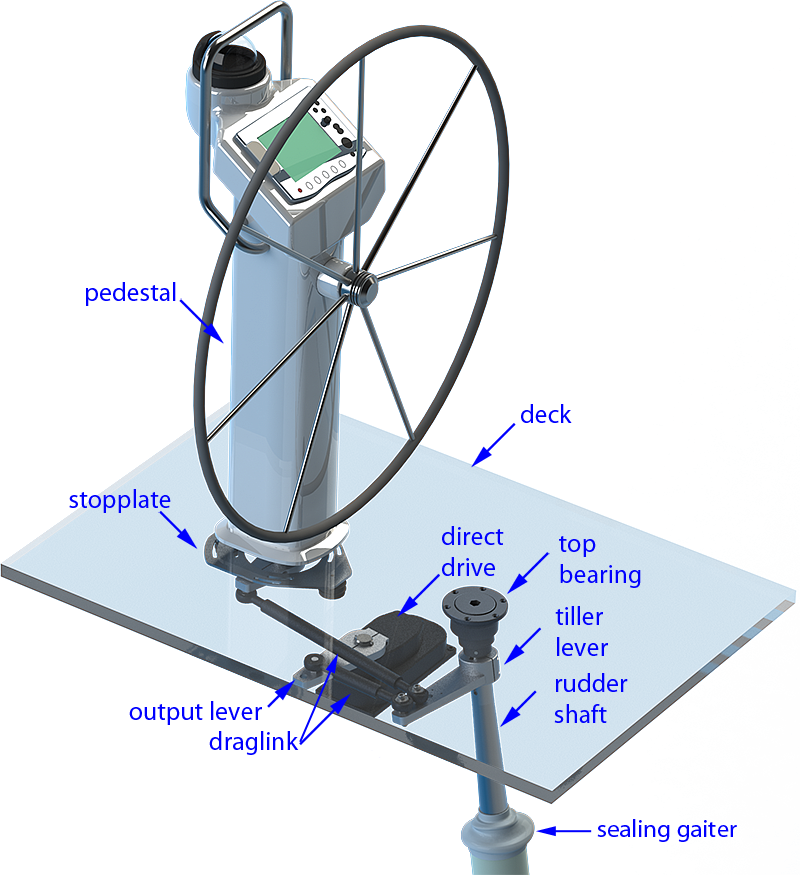
The direct drive drives the rudder via a draglink and the existing tiller arm or quadrant or via an independent tiller arm. (see illustration)
Please click on the picture for a larger view.

direct drive unit type I |
| Jefa 150 KgM autopilot direct drive unit type I |
|
The Jefa direct drive type I is an extremely strong and compact autopilot drive
and much more efficient than existing hydraulic and electro-mechanical
autopilot drive units (for the why and how, please see our
Q&A page). It's much stronger than a human being (the max. output torque of
150 KgM is equivalent to 150 Kg force on the end of a 1 meter steering
tiller) and is build
for 24 hours per day continuous operation with a total weight of only 12
Kgs. The combination of the flat wound (pancake) electric motor with the ultra efficient
planetary and spur gearbox results in an extremely efficient drive unit to keep
the battery charging time to the minimum. The drive can be used on boats
from 30 to 45 foot l.o.a. (or up to 150 Kgm rudder torque) equipped with a mechanical steering system that can
be back driven. The direct drive drives the rudder via a draglink and the existing tiller arm or quadrant or via an independent tiller arm. (see illustration) Please click on the picture for a larger view. |
|
|
|
| Main dimensions: |
|
|
| The Jefa 150 KgM direct drive type I is very compact with a length of 345 mm, a width of 164 mm and a height of 185 mm. As space is always a problem on sailing yachts, the direct drive unit can be mounted as close as 250 mm from the rudderstock even upside down. |
| Some mounting possibilities: |
|
|
| The left illustration shows the direct drive combined on the steering tiller lever. The 165 mm output centres are used to achieve the correct geometry. The right illustration shows a direct drive mounted on a separate lever independently from the steering system. |
| The two possible operation centres: |
|
|
|
Direct drive type I operating centres in mm valid for 72° (2x36°) rudder travel. |
||
| Output centre distance | Offset distance | Tiller centre distance |
| 130 | 106 | 200 |
| 165 (standard) | 127 | 250 |
| The construction: |
|
|
|
The above assembly drawing shows a cross section of the direct drive
type I. The drive can be separated in
5 main parts: The electric motor, the two step spur gearbox, the planetary gearbox,
the
electro-magnetic clutch and the final spur reduction gearbox. The Jefa
direct drive has multiple
advantages over existing integrated drive units. These advantages will
be explained per section of the drive: Electric Motor: The flat wound electric motor (pancake motor) used in the Jefa drive units is carefully selected for this application. Pancake motors have multiple advantages over normal electric DC motors:
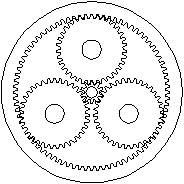
Planetary gearbox: To achieve a correct rudder travel speed (hard over time) the electric motor has to be reduced in speed with a factor 750:1. Some autopilot drive producers use a worm reduction box, but the efficiency is extremely low as the gears rub each other. The Jefa direct drive type I uses a combination of a planetary gearbox and spur gear sets (one small gear and one big gear). The planetary gearbox has following advantages:
Electro magnetic clutch: On the moment the mechanical steering system on the yacht is manually operated, the autopilot drive
has to be disconnected from the steering system. This is achieved with
the electro-magnetic clutch and controlled automatically by the
autopilot junction box. Jefa has developed a unique and patented
engagement clutch. The solution is based on two electrically operated
spring loaded clutch pins that engage and disengage the outer gear ring
of the planetary gear step. This solution has multiple advantages over
the existing friction plate clutches:
|
| The performance: |
|
|
| This performance table shows the relation between the consumed power and the output power. The red line shows the output torque against the needed amperage at midships rudder and the blue line shows the output torque against the needed amperage at full rudder. The green line shows the hard over time (time to travel 72° of rudder travel) of the drive relative to the output torque. Also visible is the strength of the drive unit related to man power. The unit is much stronger than a human being and can last much longer but one should note that when the unit is operated in the red zone, something is wrong with the trim of the boats and the sails should be adjusted to achieve lower rudder torques. The above table shows that the Jefa direct drive type I will steer the yacht even in the worst possible conditions. As the drive will mostly operate in the left green zone and will not continuously rotate, the average power consumption on 12 volts is 2 amps. |
| Connections: |
|
|
| This illustration shows the minimal components for a working autopilot configuration. Jefa autopilot drives work together with all mayor autopilot electronics. The connection of the Jefa autopilot drive to the autopilot junction box is quite simple. The two 1.5 mm² red and black wires have to be connected to the plus and minus of the autopilot clutch line. This will make sure that when the autopilot user engages the autopilot on the control screen, the clutch will engage and allow the autopilot motor to drive the rudder. The two 2 mm² red and black wires have to be connected to the autopilot drive output connection. Now the Jefa autopilot drive is integrated into the system. |
| Rudder feedback bracket: |
To ease the installation of the Jefa autopilot direct drive DD1 we have
developed a rudder feedback bracket. This bracket can be mounted in any
direction on the main outgoing housing of the drive to accommodate the
rudder feedback unit. This saves a considerable amount of installation
time as no fundament has to be made for this feedback unit. Please click
on the pictures and layout for a larger view. |
 |

|
| Drive unit specification form: |
 |
To simplify the specification of the direct drive, we developed a specification form. Please click on the picture to open this form. |
| Tiller specification form |
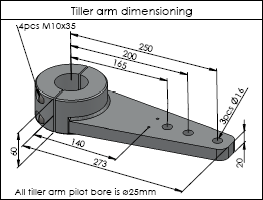 |
Please click this to open the tiller lever specification form in Adobe PDF. This is a great help to specify a tiller arm. Please sent the form to us. |
| Compatibility in 12 Volts. |
| Following table shows the maximum rudder torques at midships and full rudder that can be generated by the Jefa 150 Kgm direct drive in combination with various autopilot junction boxes. |
| Autopilot junction box 12 Volt version. | Max. output (Amp.) | Rudder torque midships (KgM) | Rudder torque full rudder (KgM) |
| Garmin GHP12 sailboat APS (*1) | 40 | 80 | 150 |
| Simrad AC12 | 12 | 80 | 150 |
| Simrad AC42 | 30 | 80 | 150 |
| Raymarine ACU-200 (*2) | 15 | 80 | 150 |
| Raymarine ACU-400 (*2) | 30 | 80 | 150 |
| NKE gyropilot 2 RVP (*3) | 25 | 80 | 150 |
| Furuno Navpilot | not advisable due to lack in speed control and dynamic braking see this page | ||
| B&G H5000 Pilot (*4) | 30 | 80 | 150 |
| B&G Tritan Pilot - Low Current | same as Simrad AC12 - see above | ||
| (*1) A special Garmin version of the direct drive is available under code number DU-DD1-12/GA. The Garmin rudder feedback unit is integrated and special Garmin cables and plugs are wired to the drive unit. |
| (*2) An internal rudder feedback unit is available for this pilot which saves installation time and a separate fundament for the external rudder feedback is not required. |
| (*3) Please read the special installation instructions for the clutch available on our FTP server via this direct link. |
| (*4) From software release 1.1.84 onwards. Older H5000 pilots should be software upgraded. For a complete list of compatible B&G autopilots please follow this link. |
Jefa direct drive unit type 1 |
||
Part No. |
Description |
|
DU-DD1-12 |
Direct drive 150 KgM type 1 12 Volts |
|
DU-DD1-12/GA |
Direct drive 150 KgM, incl. Garmin rudder feedback and cables |
|
DU-DD1-RFB1 |
DD1 integrated rudder feedback unit for Garmin and NKE autopilots (10 kΩ) |
|
DU-DD1-RFB2 |
DD1 integrated rudder feedback unit for Raymarine autopilots (5 kΩ) |
|
DU-DD1-RFB3 |
DD1 integrated rudder feedback unit for B&G (NAC-2) autopilots (5 kΩ) |
|
DU-DD1-FB |
Rudder feedback mounting bracket for DD1 |
|
| The direct drive should be completed with a draglink, a tiller pin and in some cases a tillerarm. |
| Service information: |
 |
Please click the left picture to open the Direct Drive MK2 explosion drawing with parts list. |